
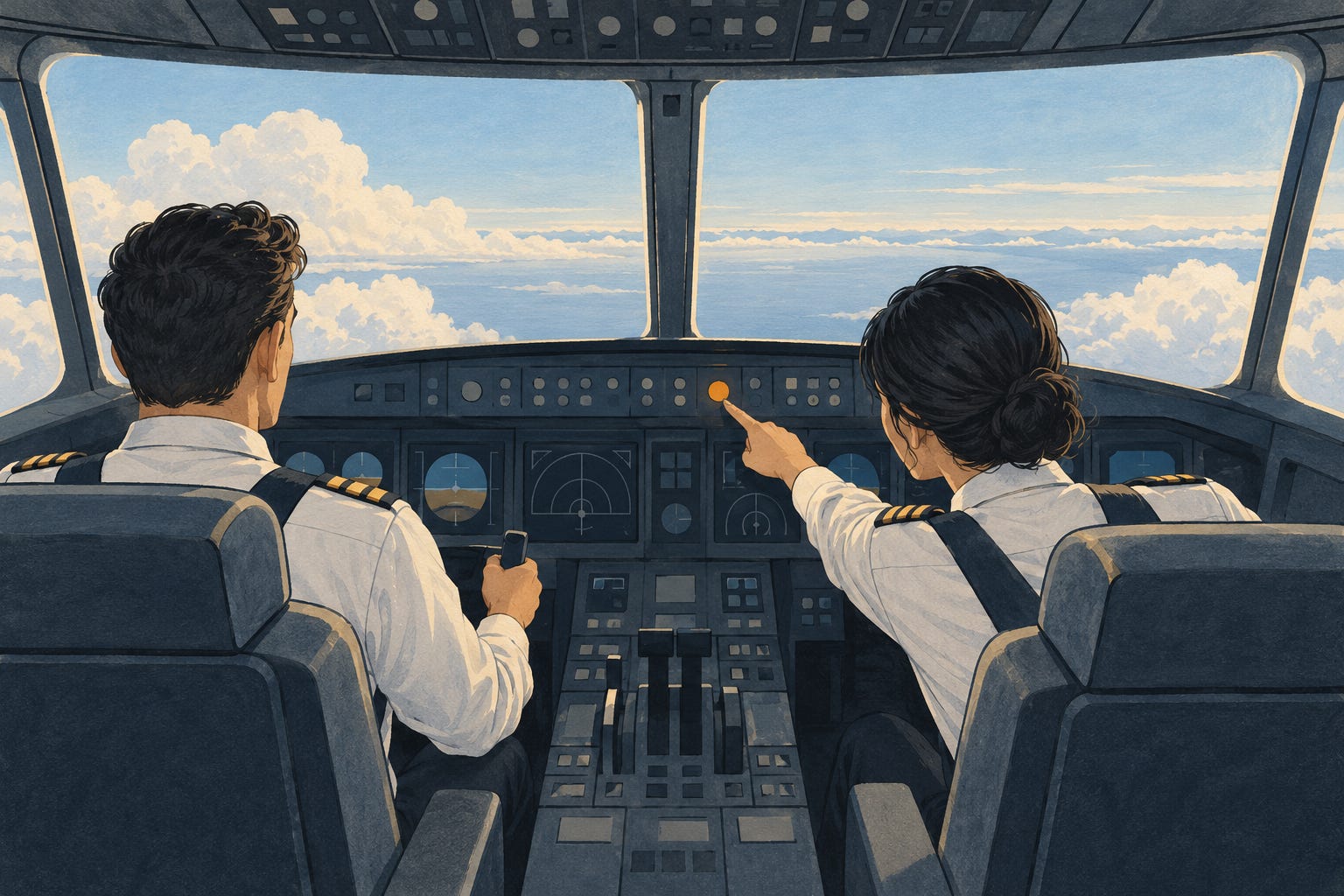
Every airliner you’ve ever boarded had two pilots up front. Only one of them was flying. The other one sat for hours with their hands off the controls, watching the instruments and saying things like “speed” and “one thousand.” I am exaggerating of course but you get the point.
Here’s why. Aircraft built to be flown by one pilot crash about three times more often per hour flown than aircraft that require two, and their crashes are about thirteen times more likely to kill someone. The American safety board went through 37 airline accidents blamed on the crew, it found the same failure in 31 of them: the pilot who wasn’t flying had not caught, or not challenged, the mistake of the one who was. The plane didn’t only go down because a pilot made a mistake. It went down because the other seat didn’t stop it.
The second pilot isn’t there just in case the first one has a heart attack. The second pilot is there because sometimes the first one can’t see their own mistakes, and because someone has to be allowed to say so, and to act on it.
Now let’s get off the plane for a minute.
Think of the best work you’ve seen inside a company. Not the best result. The best work.
Chances are one person did it. Head down, no meeting, no document with fourteen comments in the margin. Someone who knew the job, had an opinion, and did it. You know that person. You may have been that person, before the company got big enough to schedule a meeting about it.
One
That person is the best thing a company has. It’s also a lonely spot, for a reason that has nothing to do with talent: you can’t see your own work. You see the next sentence, the next visual, the next line of code. But you don't see the mistake sitting right in front of you, the twist that can transform your work. It’s also what happens when you proofread your own email. You read it five times, you hit send, the typo is in the first line. The eye reads what it meant, not what’s on the page. Skill has nothing to do with it. Distance does.
We’re wise about other people’s problems and blind about our own. Psychologists have measured it. Ask a friend about your situation, they see it in a minute. Ask about theirs, they don’t. Again, the distance does the work.
So what do most companies do when their best person can't see their own work anymore? They often hire more people to add another pair of hands.
Three, Four…
And more people should mean more work gets done. That's the whole bet behind every hiring plan. Well… In 2012, three researchers tested the idea with Lego. Pairs and teams of four built the same figure. Total minutes of work: 72 for the pairs, 111 for the fours. 54% more effort for the same result, and the bigger the team, the surer it was beforehand that it’d be quick.
Everyone you add has to talk to everyone already there. Two people, one conversation. Three kind of works, but that's where the multiplier kicks in. Four people make six conversations. Five make ten. Twenty make a hundred and ninety… When headcount adds up, conversations multiply.
And you lose something worse than time. You lose the opinion.
Post an idea in a Slack channel. Watch the fire emojis roll in. Somewhere in that channel sits the one person who knows it’s bad. Watch them type a reply, read it twice, delete it, and add a thumbs up. They joined three weeks ago. They’d like to still be there in three months.
That’s what ships. Not the best idea. The one with the most emojis.
Mix too many people and you get an average. And an average has no opinion.
So one is sometimes not enough, and four is too many. Three usually is too, because three is where you lose the ping-pong. With two, you say, I answer, the ball keeps moving. With three, one of you is waiting to play, and the game turns into a meeting.
Two
The second person is not a second pair of hands. It’s a second pair of eyes, with a grip on the work. Harder than it sounds, because the reflex is to hire hands.
Ronald Heifetz at Harvard has the image: a dance floor and a balcony. On the floor, you see the couple next to you. From the balcony, you see who’s in step, where the gaps are, who’s stepping on whose feet. In a growing company, everyone dances. The balcony stays empty.
The best CEOs I work with all have this height of view. It looks like a gift. It's mostly a position: the CEO is often the only one walking through every room. Then the company grows, the founder becomes the bottleneck, and it stays that way until they find someone whose whole job is to oversee things and act upon them proactively.
What that person actually does
The second person goes up to the balcony so the others don’t have to, and comes back down with something to say.
In a company I follow closely, there’s a role with no proper name. Call it the operator-coordinator. The job isn’t to do the work. It’s to look, point, and make sure the pointing turns into something.
The coordinator walks onto each person’s floor with balcony eyes and says what they see. Not to catch anyone out. Someone competent looking closely at your work is a form of respect. Most people get the opposite: no one looks, and everything’s fine.
Pointing is the cheap half of the job. Most companies are full of people who noticed. What's rare is someone who noticed, said it, and came back to check or act upon it. The coordinator-operator makes sure the remark becomes a change, the change becomes a rule, and the rule has an owner. The person doing the work keeps the how. The coordinator owns the whether.
That takes authority. Not the boss kind. The reassuring, empowering, hands-on kind: the coordinator doesn't manage the person and doesn't do the job for them (I mean, sometimes they do, of course… Leadership shines through example), but they mostly send the work back, hold a launch, decide that a fix found on Tuesday applies to every Tuesday after. Authority over the work, not over the person.
It’s a hundred-year-old idea. In 1926, Mary Parker Follett wrote that orders shouldn’t come from rank but from the situation: whoever sees most clearly what it demands says so, boss included. And it’s measured. Marshall Goldsmith and Howard Morgan studied 86,000 people in eight large companies who had all received detailed feedback on what to improve. Those who let it sit improved about as much as if they'd received nothing. Those who went back to their colleagues every few months to ask how they were doing improved a lot. Same feedback. The difference was someone coming back to ask what had changed.
It’s been done before
At Pixar, a group called the Braintrust watches every film while it's being made and says exactly what's wrong with it. The director is free to ignore every suggestion. But the film doesn't ship until the problem is fixed, and when the director can't fix it, Pixar changes the director. That's what saved Toy Story 2 a few months before release, and it has happened four times in eight films since.
At Amazon, every hiring decision includes one interviewer from a different team, called the bar raiser. They don’t need the position filled, so they’re in no hurry to fill it. They can block the hire. They rarely do. They don’t need to: everyone in the room knows they can.
Now, two ways it goes wrong
No teeth. After the Yom Kippur War, Israeli intelligence created a unit whose only job was to disagree with the official analysis. Its opinions were rarely followed, then rarely heard. That’s what happens when your job title is just to disagree.
Too many teeth. The coordinator starts deciding how the work gets done, and the people doing it start waiting for orders. The Red Army ran that experiment. In 1941, every commander got a political commissar at his side, equal in rank, with a signature required on every order. Fifteen months later, in October 1942, with the war going badly, Moscow abolished the system and gave commanders back full command. The reason recorded at the time: no unity of command, no trust between the two.
What to do with this
You don’t need a new title. You need the function.
Hire less. Before every hire: what happens if we don’t? Often, nothing. Sometimes, better.
Give the balcony teeth. Whoever plays coordinator can send work back and hold a launch. If they can only comment, they’re decoration.
Follow through. The person doing the work owns the fix. The coordinator comes back to check it happened. A remark with no follow-up is just a remark.
One pilot alone can't watch their own hands. Four pilots in the same cockpit can't either, they're too busy deciding who's flying. Two can. One flies. One watches, says what they see, and takes the controls if nothing changes.
Go up. Look down. Collaborate truly and make it stick :)
C'est un très bon ticket de la rentrée! Je l'a trouvé très clair et efficace !
Cela mérite d'avoir une page dans les revues d'entrepreneuriat.