The Invisible Edge
What kind of investor am I
This might be a little longer than usual. A bit more verbose. Less optimized for attention spans. But some things need space. If I’m going to talk about identity, about edge, and about what really drives me, it deserves more than a few sharp lines.
So this one takes its time.
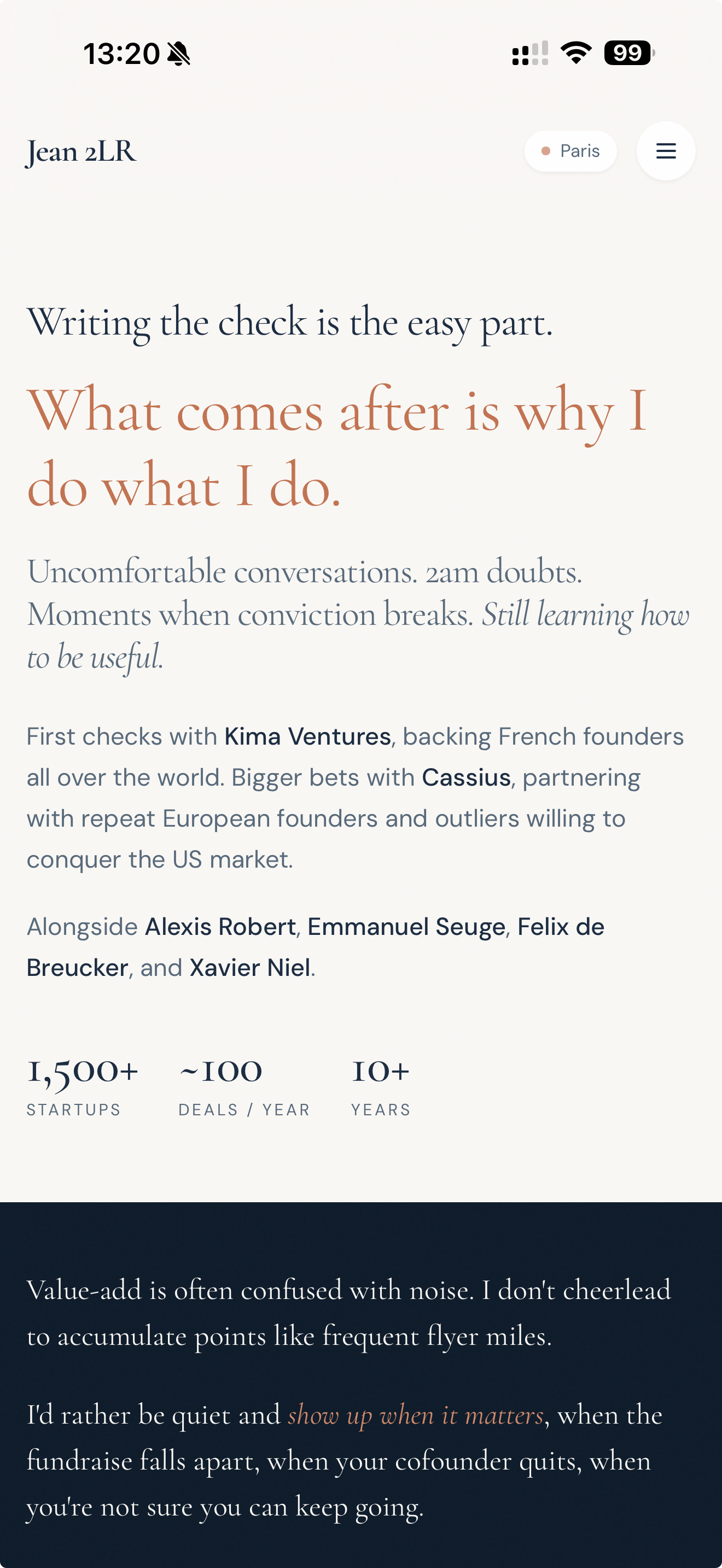
First, an announcement: 2LR is now live on iOS via TestFlight. It’s still a work in progress but it gathers everything. My content, searchable by semantics. My book in its original English version, the raw one, almost untouched since it first came out. My digital AI twin, continuously updated. Office hour slots. And through notifications, deal updates and other announcements.
Building this small app forced me to confront something I had kept slightly blurred by omission: What kind of investor am I?
Of course, I like to be the first to commit. I like to write a check when intuition beats data. I enjoy helping you thrive in your fundraising or thinking through the next inflection point.
But strip all of that away, and what’s left is simpler. And honestly, a bit uncomfortable to admit.
I am at my best one-on-one. In depth, not in surface. In tension, not in theater. I thrive in the messy middle of a conversation where there is no audience and no script. I am not a cocktail-party networker trading proximity for access. I don’t desire a board seat for the sake of the title.
I prefer being useful in the early moments that matter… intense, high-conviction… then stepping back and letting you build.
I care less about signaling and more about sensing. Less about being right in public and more about being useful in private. Less about dominating a room and more about understanding the person who’s quietly doubting themselves at 11:47 PM the night before payroll.
That’s not the loudest archetype in venture. It doesn’t trend well. It doesn’t show up cleanly in a quarterly report. It is harder to quantify, and harder still to explain.
For a long time, I thought that meant it was weaker. I was wrong. It’s just different.
My edge isn’t performance. It’s presence.
The Training
I grew up introverted. Hyper-sensitive. Vulnerable in a way that felt dangerous.
School wasn’t a place where I felt strong. I struggled to understand the instructions. I had trouble concentrating. I was often somewhere else in my head, drifting. I didn’t take notes, not out of rebellion or indifference, I was just lost.
So, the safest strategy was invisibility. Don’t raise your hand. Don’t make noise. Don’t attract attention.
I stayed in the background. And over time, the background becomes an identity. You stop expecting to be central; you start assuming you are secondary.
When you grow up doubting yourself, you develop a constant internal question: Am I enough? That doubt can shrink you. It can make you cautious.
But it also sharpens you.
If you’re not the one speaking, you’re the one observing. If you’re not performing, you’re listening. You start noticing tone shifts before words change. You pick up hesitation in a sentence. You sense what’s being avoided as much as what’s being said. You learn to read the room without trying to win it.
For a long time, I framed that as fragility. Today, I see it as training.
Yet, invisibility has a cost. When you repeatedly position yourself on the margins, you internalize the role. You become the secondary character in your own story.
But after years of that, a quiet drive emerges: the need to matter. Not to be admired, but to be essential. To be the person who counts when the lights are off.
Because when you grow up hiding, there’s a strange paradox: you want help, but you make sure no one sees that you need it. You struggle quietly. You are lost, but invisible. And if no one steps in, it’s partly because you’ve mastered the art of not being noticed.
You learn to handle it alone.
At some point, that turns into an instinct. It’s as if you couldn’t quite save yourself back then, so now you develop an obsession with being present for others in a way you never experienced.
To notice when someone is drifting. To feel when a founder is spiraling internally while keeping a composed exterior. To sit with them when things are heavy instead of retreating into analysis.
That instinct never left me.
The Identity
Writing a check is easy. Pattern recognition is easy. The investor job can be done in a thousand technically competent ways. But when we hire at Kima, I always say: Find your edge. Find what makes you identifiable. Not better. Identifiable.
For a while, I wasn’t sure mine was strong enough. It wasn’t flashy. It wasn’t a bullet point. But it’s real.
What moves me is not just markets, it’s the people. I feel founders. Their doubt. Their ambition. Their contradictions. I can sit on a one-hour call and be genuinely transported by the tension between who they are and what they’re trying to build.
That sensitivity, the one I used to hide, is my edge.
It allows me to be steady when conviction fades. It allows me to listen without trying to control the room. It doesn’t always click; you don’t connect with everyone. But when it does, it’s powerful.
2LR is simply a way to make that DNA a bit accessible. You can search the content. You can read the book. You can interact with the digital twin, an AI trained on my meetings, my frameworks, my patterns. It won’t replace human connection, but it can challenge assumptions and cut through the noise.
And I’m opening office hour slots for portfolio founders of course, and for other entrepreneurs and operators in the arena who just need fifteen minutes of clarity.
2LR is an interface. The real subject is identity.
For years, I thought my introversion and my vulnerability were flaws to be neutralized with visibility. So I became visible. I spoke on stages. I leaned into presence. From the outside, it looked like confidence.
But visibility can be armor. Performance can be protection. You can be very public and still very concealed.
Building this forced me to stop performing and start owning. My hypersensitivity is not fragility. It is a structural advantage. It is the reason I can sit in discomfort without rushing to fill the silence. It is the reason founders open up beyond the deck, beyond the metrics, beyond the narrative.
For years, I made sure that if I was seen, it was on my terms, through a layer of control.
Today, I choose something different. I choose to be seen without armor. Exactly as I am.